Final Project Proposal
01 Apr 2026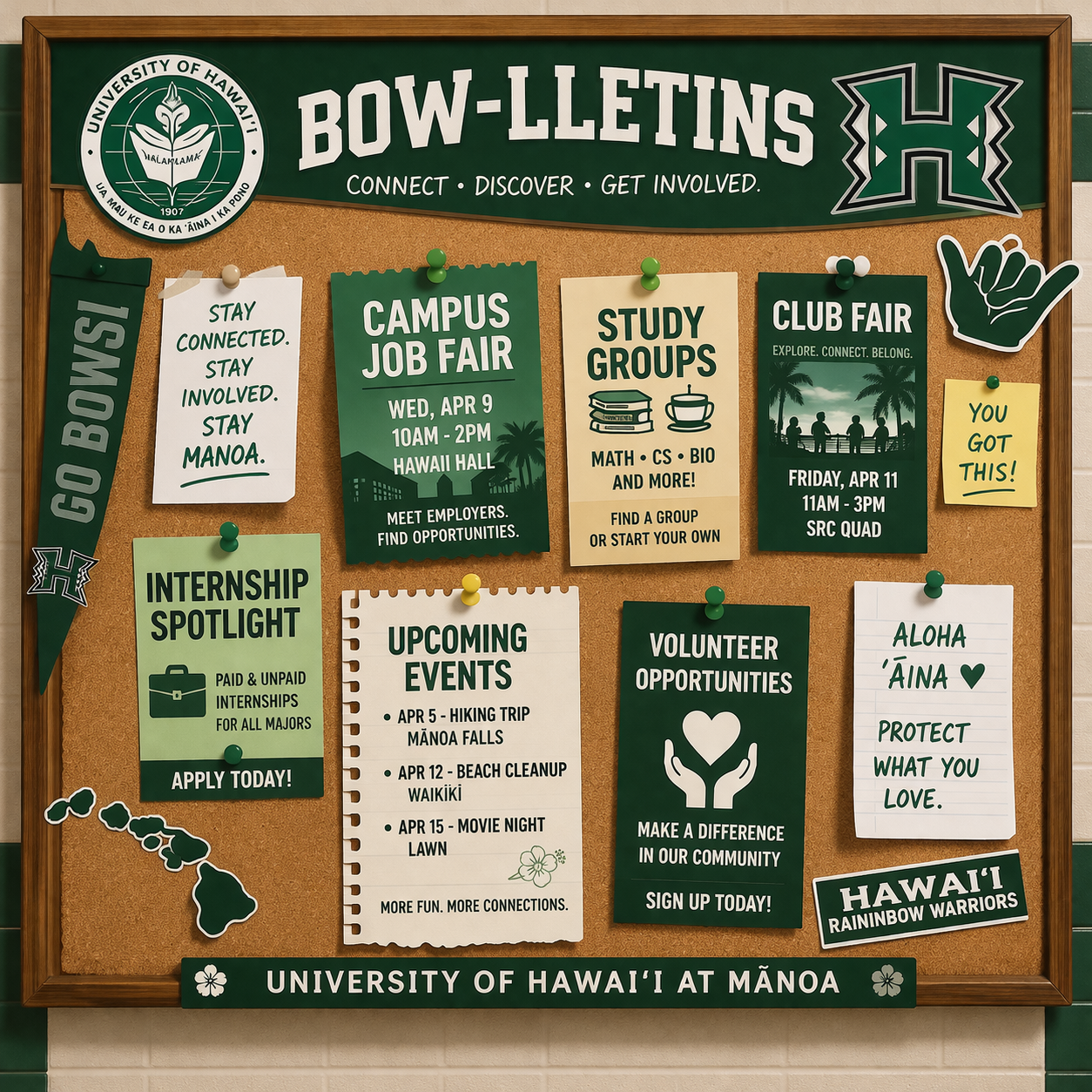
Bow-lletins: A Digital Bulletin Board for UH Mānoa
UH Mānoa is a large campus with a lot happening at any given time. There are club meetings, study groups, internship opportunities, campus jobs, volunteer events, scholarship deadlines, and community announcements constantly being shared. The problem is not that opportunities do not exist; it is that students often never see them in time. Information is scattered across Instagram stories, physical bulletin boards, Discord servers, flyers taped to walls, club pages, email newsletters, and word of mouth. Because of that, many students miss out simply because they did not know where to look.
Our proposed project, Bow-lletins, is a digital bulletin board platform designed for UH Mānoa students and affiliates. The goal of this application is to create one centralized place where campus opportunities and announcements can be posted, discovered, searched, and saved. Instead of relying on luck, students would have a reliable and organized way to stay informed about what is happening around campus.
Bow-lletins would be built using Next.js, React, Bootstrap 5, and GitHub for collaboration and hosting. The application would focus on the needs of the UH Mānoa community by helping students connect with resources, organizations, events, and each other in a way that feels modern, accessible, and relevant to everyday student life.
The problem
One of the biggest challenges at a university as large as UH Mānoa is visibility. There are many great opportunities available, but they are often hidden in places students do not regularly check. A flyer posted in one building might never be seen by students in another. An internship announcement shared on one club page may only reach students already in that circle. Even campus events with strong turnout potential can go unnoticed if promotion is scattered or inconsistent.
This creates an access problem. Students who are already well connected tend to hear about more opportunities, while others may miss them entirely. That is especially frustrating for commuter students, transfer students, first-year students, and students trying to get more involved but not knowing where to begin. In a big university, connections do not always happen naturally. Students need tools that make campus life easier to navigate.
The solution
Bow-lletins solves this by acting as a digital campus bulletin board. Students, organizations, and campus groups could create posts for events, jobs, study sessions, internships, deadlines, and announcements. Other users could browse these posts in one place, filter them by category, search for specific topics, save interesting flyers, and interact with posts through comments, reactions, or RSVP features.
What makes Bow-lletins more than just a basic posting board is its personalized experience. After registering and logging in, each user would have their own state within the system. They could save posts they want to revisit, track events they plan to attend, manage their own uploads, and view content that is more relevant to their interests. This gives the app the required “special sauce” because the application behaves differently depending on the user and their activity.
For UH Mānoa students, this could make campus life feel less fragmented. Instead of asking around or checking five different platforms, they would have one organized space for discovering opportunities and staying connected.
Names of the proposers
Tamela Brinson
Annie Pham
Terisa Lau
Caden Tran
Thomas Tran
Mockup page ideas
One of the most appealing parts of this project is that it naturally supports several pages with clear purposes and strong visual design opportunities.
Landing Page
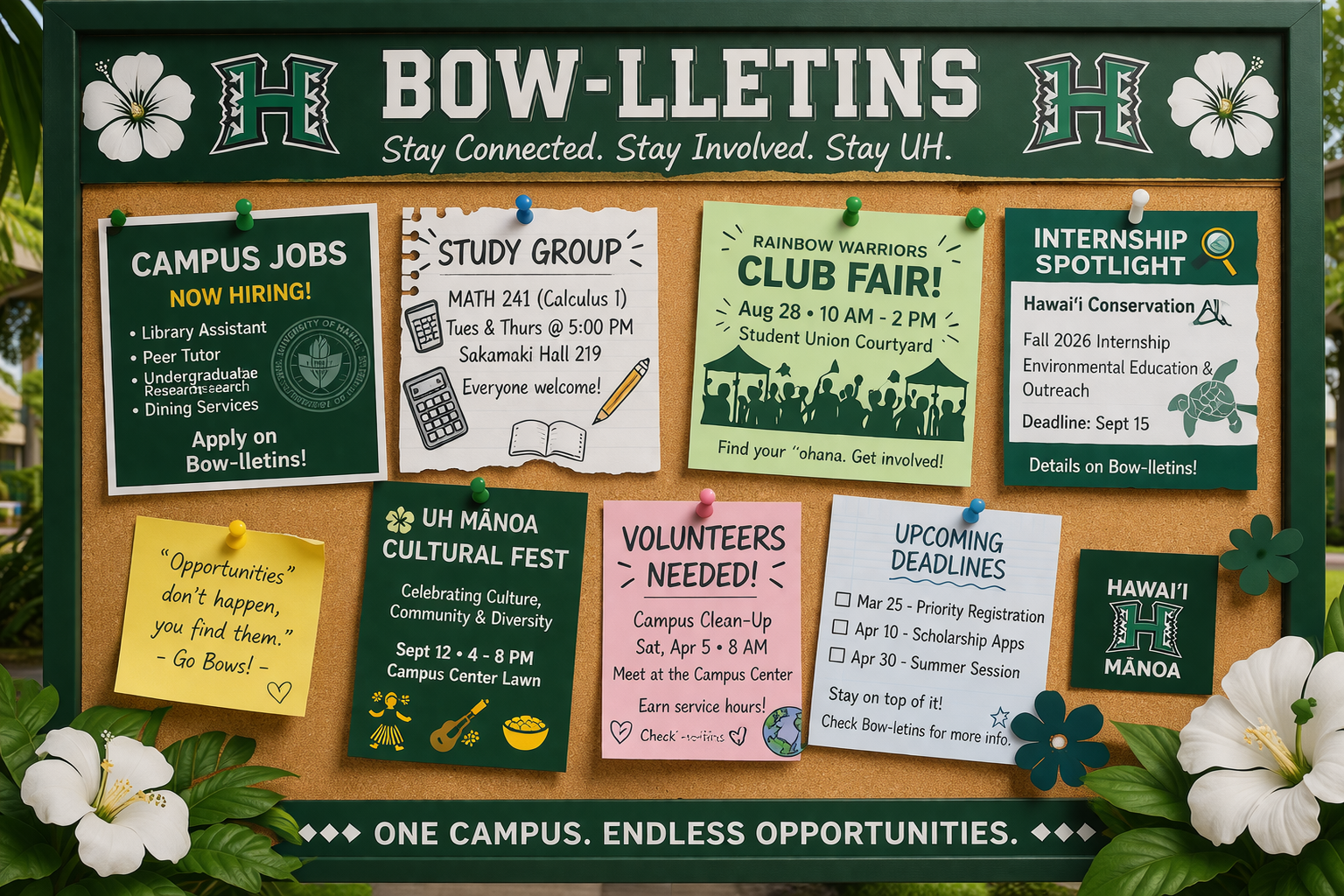
The landing page would introduce Bow-lletins with a welcoming, campus-focused design. We imagine a corkboard-style background paired with a UH-inspired green color palette to make the theme feel familiar and local. This page would include the app logo, login and sign-up buttons, and a search bar that immediately shows the app’s purpose. A preview grid of example flyers could give users a quick look at the kinds of content available, such as jobs, events, study groups, and deadlines.
Home Bulletin Page
This would be the main feed of the platform. Posts would appear as flyer-style cards pinned in a grid layout, making the site visually resemble a digital bulletin board. Users could browse all posts, search by keyword, and filter by categories such as Jobs, Internships, Events, Clubs, Study Groups, Housing, or Announcements. This page would be the center of the user experience.
Flyer Detail Page
When a user clicks on a flyer, they would be taken to a detail page with full information such as title, description, date, location, contact details, and attached image. This page could also include reactions, comments, and an RSVP option for event-based posts. Instead of just reading a static announcement, users would be able to engage with it.
Create Post Page
This page would allow creators to make a new flyer. They could fill out a form with fields like title, category, description, date, location, and image upload. They could also toggle whether comments or RSVP are enabled. Our current concept also includes an AI-assisted flyer generator, which could help users create more polished visuals even if they have little design experience.
Profile Page
Each user would have a profile page showing their information, saved posts, and created posts. This gives users a sense of ownership and personalization. It also allows creators to manage their flyers and let students quickly revisit announcements they were interested in.
Use case ideas
Bow-lletins supports multiple kinds of users, each with a different relationship to the platform.
Student
A student can sign up and log in, browse flyers, search for specific opportunities, and filter posts by category. They can click into a post to view more details, react to it, comment on it, save it for later, or RSVP if it is an event. They can also visit their profile to manage their saved flyers and track what they are interested in.
A realistic example would be a student looking for an internship. Instead of checking random social media accounts or hoping a professor mentions something, they could open Bow-lletins, filter by Internships, search by major or interest area, and save the ones they want to apply to later.
Creator
A creator could be a club officer, campus organization member, student worker, or anyone authorized to post announcements. They can create a flyer, upload an image, optionally use the AI flyer generator, and control whether comments or RSVP are available. They can also edit or delete their posts and view engagement data, such as reactions or responses.
For example, a registered student organization planning a fundraiser could use Bow-lletins to create a post, upload a flyer, enable RSVP, and monitor how many students interact with it.
Admin
Admins would help maintain the quality and safety of the platform. They could review reported content, remove inappropriate flyers or comments, and moderate posts to keep the app useful and respectful for the campus community.
This is especially important because a public posting platform needs some level of accountability and moderation to remain trustworthy.
Beyond the basics
The required technologies alone do not make a project interesting. What makes Bow-lletins stand out is that it combines a practical campus need with a more interactive and personalized user experience.
The first major feature beyond the basics is individual user state. Once logged in, users can save flyers, manage their own posts, track RSVP activity, and interact with announcements in ways that reflect their own interests. This turns the app into more than a static board. It becomes a personalized campus engagement tool.
The second major feature is community interaction. Physical bulletin boards do not let students respond, ask questions, or show interest. Bow-lletins adds comments, reactions, and RSVP options, which make announcements feel more alive and useful. A flyer is no longer just information taped to a wall. It becomes something students can actively engage with.
The third feature is AI-assisted flyer generation. While still conceptual, this would help users who have something important to share but lack design experience. Instead of struggling to make a flyer look presentable, they could use built-in assistance to generate a cleaner visual. That lowers the barrier to posting and makes the platform more inclusive.
Finally, Bow-lletins is especially worth building because it serves a real local community we understand well. UH Mānoa is large enough that students regularly miss opportunities, but also connected enough that a centralized platform could genuinely improve communication. This app is not solving a made-up problem. It addresses a real gap in how students find ways to get involved, stay informed, and connect with campus life.
In a university environment, access to information can shape who finds internships, who joins organizations, who attends events, and who feels included. Bow-lletins would help make that access more equal, more organized, and more student-friendly.
Why this project matters
A strong final project should not only demonstrate technical skills, but it should also solve a meaningful problem for a real community. Bow-lletins does both. It uses the required software stack, includes personalized features beyond a simple CRUD application, and is clearly designed around the needs of the UH Mānoa community.
More importantly, it reflects a real student experience. Many students want to be more involved, but the problem is not always motivation. Sometimes the problem is visibility. If information is difficult to find, students are excluded before they even get a chance to participate. Bow-lletins help reduce that barrier.
This project is worth making because college is about more than classes. It is also about connection, opportunity, and community. A platform that helps students discover those things more easily could have a real impact on campus life.
AI Use Disclosure
I used ChatGPT to help brainstorm, organize, and revise this essay. The project idea, structure, and final content were developed and edited by our team.